# Mian Was Born With One Blue Eye and One Brown Eye, Captivating Everyone—Until a Nurse Whispered Something That Changed the Entire Family’s Joy into Shock.
I will never forget the moment my daughter Mian opened her eyes for the first time. It was supposed to be the happiest day of our lives, and it truly was—until one quiet sentence from a nurse changed everything. 😨💔
After nine long months of waiting, worrying, and dreaming, I finally held my beautiful baby girl in my arms. My husband, Michael, stood beside my hospital bed, his eyes filled with tears as he gently touched her tiny hand.
“She’s perfect,” he whispered. “Look at her, sweetheart.”
I looked down, smiling through my tears. Mian had a delicate little nose, soft cheeks, and a beautiful head of dark hair. But there was something about her eyes that made everyone in the room stop and stare.
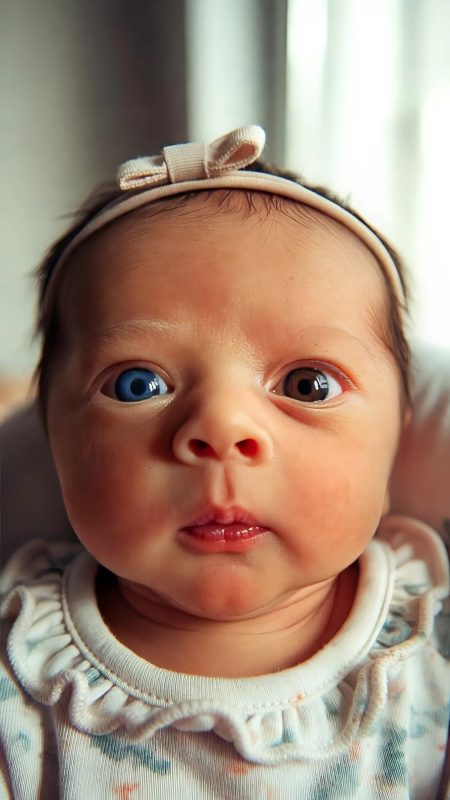
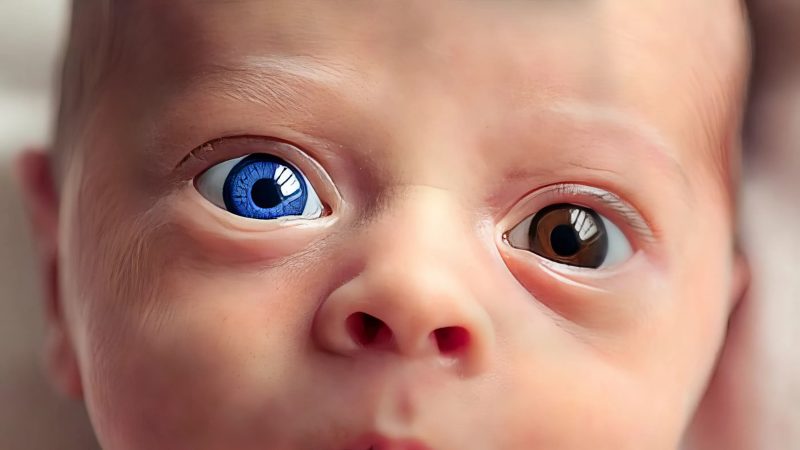
One eye was a stunning shade of blue, like the clearest summer sky. The other was warm brown, resembling melted chocolate. 💙🤎
“Have you ever seen anything like that?” Michael asked the nurse.
The nurse smiled.
“It’s called heterochromia. It means a person has two different-colored eyes. It can be a completely harmless natural variation.”
My husband looked amazed.
“She’s unique,” he said proudly.
Soon, our family members gathered around the hospital bed. Everyone wanted to see Mian’s unusual eyes. My mother called her a little miracle, while my sister immediately began taking pictures.
“She looks like a doll!” someone exclaimed.
I couldn’t stop smiling. I had imagined holding my daughter thousands of times, but I had never imagined she would have such extraordinary eyes. 🥹❤️
Then something unexpected happened.
One of the nurses, who had been quietly observing Mian, approached the bed. She gently examined the baby’s face and looked carefully at both of her eyes.
At first, I thought she was simply admiring her.
But then her expression changed.
She glanced toward another nurse, whispered something, and quickly stepped away.
I noticed the sudden silence.
“Is something wrong?” I asked.
The nurse returned a moment later, trying to maintain a reassuring smile.
“It’s probably nothing to worry about,” she said. “But the pediatrician would like to examine your daughter a little more closely.”
My heart began racing.
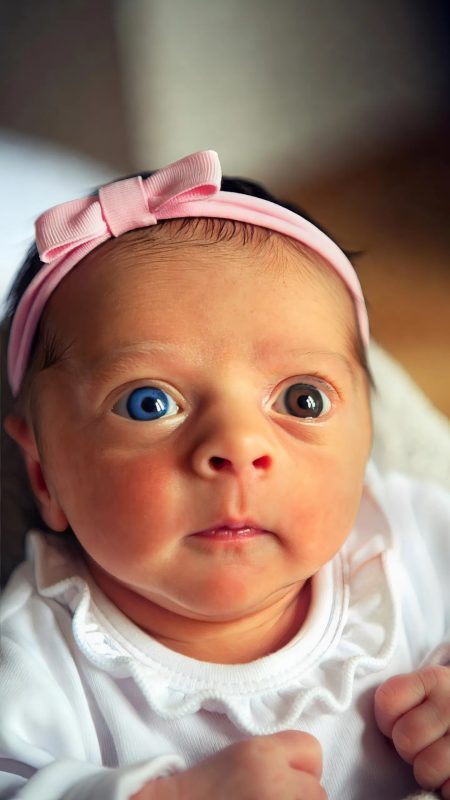
“Why? Is something wrong with her eyes?”
Michael immediately moved closer to the bed.
The nurse hesitated before answering.
“We noticed a small difference in how her pupils respond to light. Different eye colors alone aren’t usually a problem, but this particular finding deserves a closer examination.”
The happiness in the room suddenly turned into fear. 😢
A few minutes later, the pediatrician arrived. He carefully examined Mian’s eyes using a small medical light. He checked her pupils, watched how they reacted, and asked us several questions about our family medical history.
I held Michael’s hand so tightly that my fingers began to hurt.
“Doctor, please tell us honestly,” I whispered. “Is our baby going to be okay?”
He looked at us calmly.
“First, I want you to understand that having two different-colored eyes does not automatically mean a child has a medical condition. However, one of Mian’s pupils seems to react differently, so I would like an ophthalmologist to examine her.”
Those words didn’t completely reassure me, but they gave me a little hope.
The following morning, a pediatric ophthalmologist came to the hospital. She performed several careful examinations and explained that some babies naturally have different-colored eyes, while other findings may occasionally be associated with conditions affecting the eye or the nerves that control it.
Then she told us something we hadn’t expected.
“Mian’s eye colors may simply be a beautiful natural variation,” she explained. “However, we have noticed a slight difference in her pupil response. We need additional tests to understand why.”
My husband looked worried.
“Are you saying she might have a serious illness?”
“Not necessarily,” the specialist replied gently. “We shouldn’t jump to conclusions. The examination is meant to rule out possible causes and make sure she receives the right care if anything needs attention.”
Over the next few days, Mian underwent additional examinations. We waited anxiously for every result, barely sleeping and constantly watching our little girl. 💔
Finally, the specialist returned with an update.
She explained that the examinations had not revealed an emergency or evidence of a serious underlying condition. Mian’s different-colored eyes appeared to be a natural form of heterochromia. However, because of the initial difference in pupil response, the doctors recommended regular follow-up appointments to monitor her vision and eye development.
I felt as though I could finally breathe again.
“So she can grow up normally?” I asked, my voice trembling.
“Based on what we’ve found so far, there is every reason to be hopeful,” the doctor answered. “We’ll continue monitoring her, but there’s no reason to treat her beautiful eyes as something frightening.”
Michael leaned over Mian’s crib and kissed her forehead.
“She doesn’t have to look like anyone else,” he whispered. “She’s our little girl, and we love every part of her.”
I looked at my daughter again. One blue eye. One brown eye. Two tiny windows into a life we were only beginning to discover. 💙🤎
That day taught me something I will never forget.
Sometimes, the things that make our children different are not something to fear. And sometimes, the most important thing a parent can do is listen carefully, ask questions, and make sure their child receives the attention they need.
Mian’s eyes still captivate everyone who meets her.
But to us, she is much more than a beautiful pair of unusual eyes.
She is our daughter, our greatest happiness, and the little miracle who taught us that love should always be stronger than fear. ❤️👶