# Red Marks Suddenly Appeared Around My Four-Month-Old Daughter’s Mouth, and I Feared the Worst, but the Doctor’s Unexpected Explanation Left Me Speechless
I noticed the red marks while changing my four-month-old daughter Lily after her morning nap. At first, I thought they were just a little irritation from her pacifier. But when I gently turned her face toward the window, my heart nearly stopped. There were several small red spots around her mouth, some looking almost like tiny blisters. 😟
“Michael, come here! Something is wrong with Lily!” I called to my husband.
He hurried into the nursery, still holding his coffee. The moment he saw our daughter’s face, his expression changed.
“Are those… blisters?” he asked quietly.
“I don’t know,” I whispered. “But what if it’s herpes?”
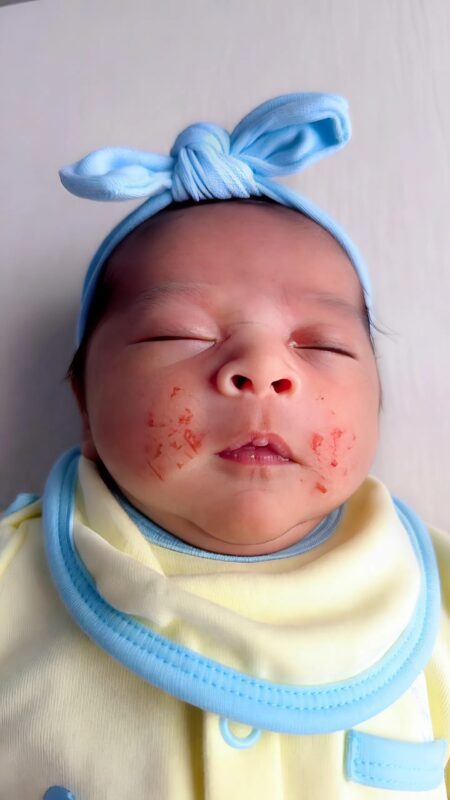
The word terrified me. Lily was only four months old. She couldn’t tell us if something hurt, and the thought of her having a serious infection made my stomach twist. I immediately began searching online, but every article seemed more frightening than the last. Some mentioned infections, others warned about viruses that could be dangerous for newborns. 😢
Michael gently took my phone from my hands.
“Let’s not diagnose her using the internet,” he said. “We’ll call the pediatrician.”
I knew he was right, but waiting felt impossible.
Our pediatrician’s office managed to fit us in that afternoon. I spent the entire morning watching Lily. She seemed perfectly normal. She smiled when I spoke to her, kicked her little legs, and eagerly drank her milk. Yet every time I looked at those red marks, my anxiety returned.
At the clinic, Dr. Anderson examined her carefully. He looked around her mouth, checked her temperature, and asked several questions.
“When did you first notice these spots?” he asked.
“This morning. They weren’t there yesterday,” I replied.
“Has she had a fever? Has she been unusually sleepy or refused her milk?”
“No. She’s behaving exactly like herself.”
The doctor nodded and leaned closer to examine the marks.
“Have you recently introduced a new pacifier, bottle, lotion, or laundry detergent?”
I paused.
“Actually, yes. We bought her a different brand of pacifiers last week. But I didn’t think that could cause something like this.”
Dr. Anderson didn’t answer immediately. Instead, he asked me to describe how often Lily used it.
“Almost all day,” I admitted. “She loves sucking on it, especially when she’s falling asleep.”
He gently examined the skin around her lips once more. Then he looked at me with an expression I couldn’t quite understand.
“I want to reassure you about something,” he said. “These marks don’t look like a typical herpes outbreak.”
I felt my shoulders relax slightly, but I wasn’t ready to celebrate.
“Then what is it? Could it still be something dangerous?”
He pulled his chair closer.
“Based on what I’m seeing and what you’ve told me, this may be a form of irritation caused by repeated moisture and friction around her mouth.”
I blinked.
“Moisture? You mean her saliva?”
“Exactly,” he explained. “At this age, babies produce more saliva, even before their first teeth appear. They also spend a lot of time sucking on pacifiers. When saliva collects around the lips and stays against delicate skin, it can cause redness and irritation.”
I stared at him.
“So you’re saying the marks might be from drooling?”
He smiled gently.
“Yes. It can look alarming, especially when the irritation appears suddenly. The new pacifier may also be contributing if its shape or material is rubbing against her skin.”
I felt a strange mixture of relief and embarrassment. I had spent hours imagining the worst, while the explanation might have been something as ordinary as drool. 😳
But I still had one question.
“Doctor, how can we be sure it isn’t herpes?”
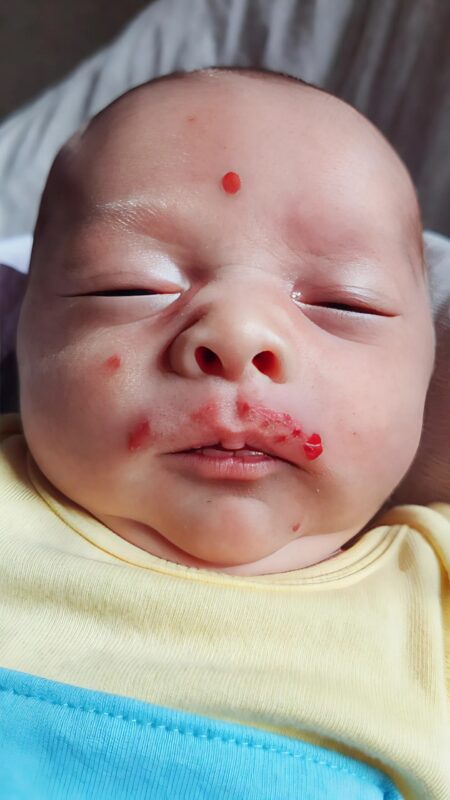
He explained that appearance alone doesn’t always establish a diagnosis. If the marks changed, developed into painful blisters, spread, or were accompanied by fever or unusual behavior, Lily would need prompt reassessment. He also told us to seek urgent medical attention if she became difficult to wake, refused feeds, or seemed seriously unwell.
He recommended keeping the area gently clean and dry, patting it rather than rubbing, and avoiding scented products. He also advised us to monitor the skin and return if it didn’t improve.
Before we left, he looked at Lily, who was happily chewing on her fingers.
“She’s a little explorer,” he joked. “Her mouth is discovering the world before the rest of her can!”
For the first time that day, I laughed. ❤️
At home, Michael carefully put away the new pacifiers while I cleaned Lily’s face with a soft, damp cloth. We watched her closely over the next couple of days, following the doctor’s advice.
Gradually, the redness began to fade.
Every morning, I checked her little face, hoping to see more improvement. And each time she smiled at me, I felt a little more like myself again.
A few days later, I sent Dr. Anderson a photograph of Lily’s face. He replied that the improvement was encouraging, but reminded us to have her examined again if the irritation returned or anything changed.
That evening, as I held my daughter against my chest, I thought about how quickly fear can take over when you’re a parent. One small change can make your imagination run wild.
I kissed Lily’s forehead and whispered, “You gave Mommy quite a scare, little girl.” 🥹
Michael wrapped his arms around us.
“Next time, let’s call the doctor before searching online,” he said with a smile.
I laughed and nodded.
But just as I was putting Lily into her crib, I noticed something unusual.
There was a tiny red mark beneath her lower lip that hadn’t been there that morning.
I froze.
Was the irritation returning, or was something else happening?
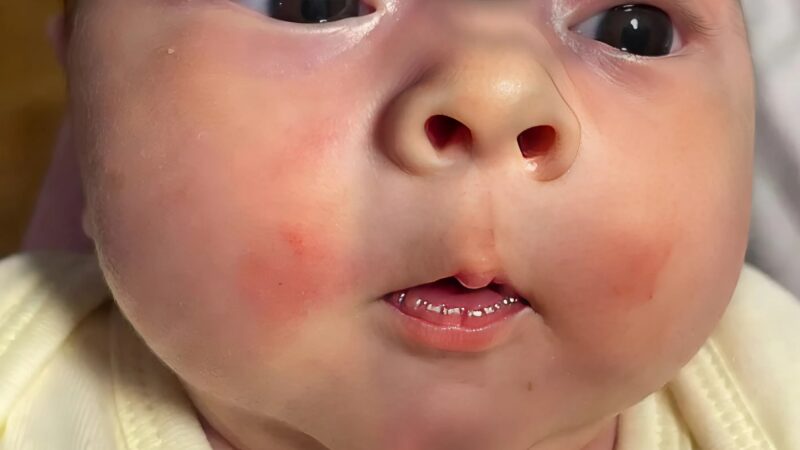
I picked up my phone and looked at the photograph I’d sent the doctor.
Then I noticed something I hadn’t paid attention to before…
The marks weren’t appearing in exactly the same places.
And suddenly, I had another question I couldn’t stop thinking about. 💔