# After My Son Was Born with Down Syndrome, I Signed the Papers to Give Him Up, Until a Nurse Revealed a Shocking Truth
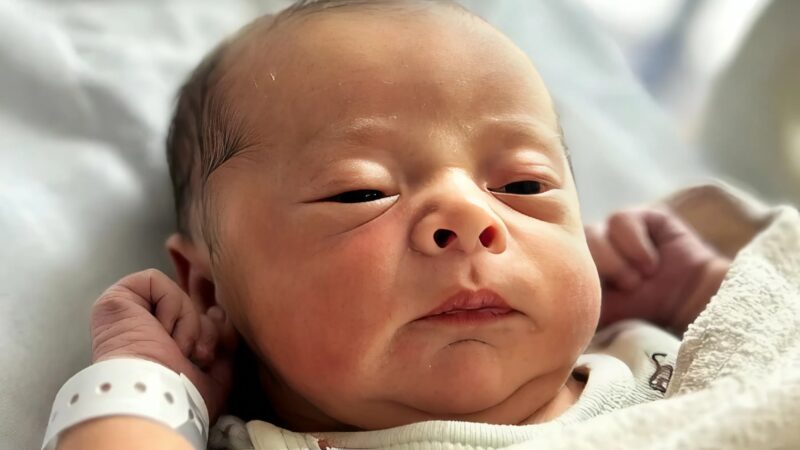
The moment I heard my newborn son’s first cry, I should have felt nothing but happiness. Instead, I stood frozen beside the hospital bed, staring at the tiny baby wrapped in a white blanket, while tears streamed silently down my face. 💔👶
My name is Emma, and until that morning, I had imagined my life unfolding very differently.
My husband, Daniel, and I had spent nine months preparing for our first child. We had painted the nursery pale blue, assembled a little wooden crib, and chosen the name Noah. Every night, Daniel would place his hand on my belly and whisper, “I can’t wait to meet our little boy.” ❤️
But everything changed when the doctor entered my hospital room with a serious expression.
“Emma,” he began gently, “your son has physical characteristics associated with Down syndrome. We need to perform further examinations to confirm his diagnosis.”
I felt the room spinning around me.
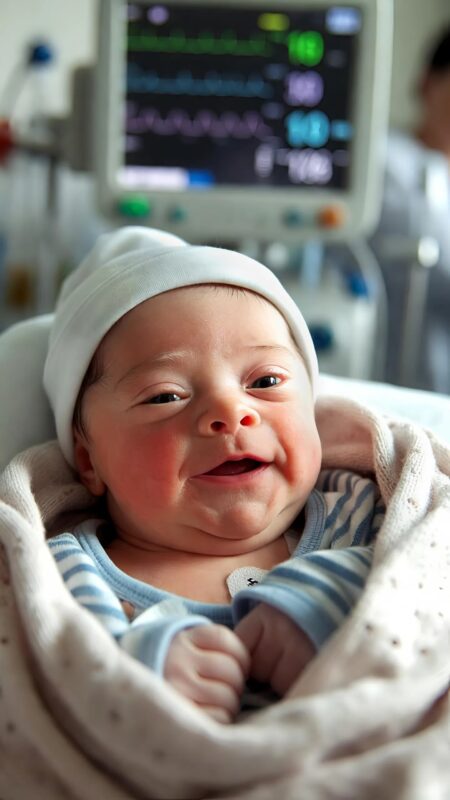
“Down syndrome?” I whispered. “Are you sure?”
“The initial findings strongly suggest it,” he replied. “We will explain everything and connect you with specialists who can help your family.”
I barely heard the rest of his words.
All I could think about was the future I had imagined disappearing before my eyes. I pictured hospital appointments, sleepless nights, worried relatives, and a life filled with difficulties I didn’t understand.
When Daniel arrived, carrying a small bouquet of pink roses, I couldn’t look at him.
“Where is Noah?” he asked, smiling.
I pointed toward the bassinet.
He approached our son, lifted him carefully into his arms, and kissed his forehead.
“He’s beautiful, Emma,” Daniel whispered, his eyes shining. “Look at those tiny fingers.”
But instead of sharing his happiness, I burst into tears.
“I can’t do this,” I sobbed. “I don’t know how to raise a child with special needs. What if I fail him? What if his life is full of suffering?”
Daniel sat beside me and reached for my hand.
“We’ll learn together,” he said. “He’s our son. We don’t have to understand everything today.”
But fear had already taken control of me.
Over the next two days, I refused to hold Noah for more than a few seconds. Whenever a nurse brought him to my bedside, I turned my face toward the window. I convinced myself that keeping my distance would somehow make the decision easier.
On the third morning, I asked a hospital social worker about the possibility of placing my baby for adoption.
Daniel was devastated.
“Emma, please,” he whispered, standing beside my bed. “Let’s take him home. Let’s meet other families and learn what support is available. We don’t have to face this alone.”
I shook my head.
“I’ve made my decision.”
With trembling hands, I signed the preliminary paperwork to begin the process of relinquishing my parental rights. Each signature felt like another piece of my heart breaking away. 😢
Just as I put down the pen, a nurse named Margaret entered the room.
She was in her late fifties, with silver hair and warm brown eyes. She had cared for Noah since his birth, and I had noticed how gently she spoke to him whenever she thought nobody was watching.
She looked at the papers, then at me.
“May I speak with you privately, Emma?”
I nodded.
Margaret pulled a chair beside my bed and sat down.
“Before you make a decision that will change both your lives forever, I want you to meet someone.”
I frowned.
“Who?”
“My daughter,” she answered. “She has Down syndrome. She’s twenty-eight years old, works at a local library, lives independently with some support, and has a wonderful circle of friends.”
I stared at her, unable to speak.
Margaret continued softly, “When she was born, people told me she would never learn, never work, and never have a meaningful life. Some even suggested that I should give her up.”
Her eyes filled with tears.
“I was terrified, just like you. But my daughter taught me that a diagnosis cannot tell you everything about a person. She has dreams, disappointments, talents, and a heart that loves fiercely. She isn’t a tragedy, Emma. She’s a person.”
Then Margaret reached into her pocket and showed me a photograph.
A smiling young woman stood beside Margaret in front of a library, holding a bouquet of sunflowers. 🌻
“She chose those flowers for me,” Margaret said with a trembling smile. “Every year, on my birthday, she brings me sunflowers because she knows they’re my favorite.”
I looked at the photograph, and something inside me began to crack—not from fear this time, but from shame.
Margaret gently placed her hand over mine.
“Your son doesn’t need you to know everything about his future. He needs you to give him a chance to have one.”
Then she said the words I would remember for the rest of my life:
“Emma, you are not being asked to raise a diagnosis. You are being given the chance to raise your son.” ❤️
I looked toward Noah’s bassinet.
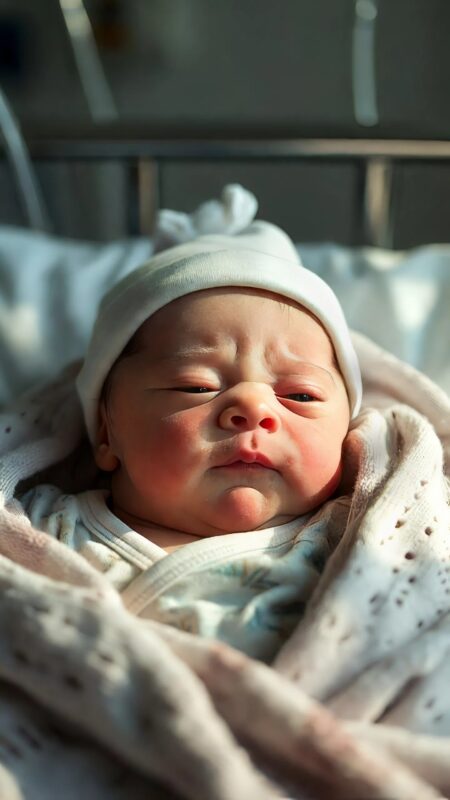
For the first time since his birth, I noticed how peacefully he slept, his tiny mouth slightly open, one little hand curled beside his cheek.
He wasn’t asking me to predict his future.
He wasn’t asking me to be perfect.
He was simply my baby.
“Can I hold him?” I whispered.
Margaret smiled and carefully placed Noah in my arms.
The moment his tiny fingers wrapped around mine, I broke down completely. I pressed my lips against his forehead and sobbed.
“I’m sorry, sweetheart,” I whispered. “I’m so sorry I let my fear come between us.”
Daniel came closer, wrapped his arms around us, and kissed Noah’s head. The three of us stayed together, crying and holding one another. 🥹❤️
That afternoon, I asked the social worker to stop the relinquishment process while we explored our options and learned about the support available to families like ours.
Our journey wasn’t suddenly easy. There were appointments, difficult questions, and days when uncertainty returned. But we found specialists, connected with other parents, and began building a future around Noah’s needs, abilities, and happiness.
Months later, I watched my son smile at his father for the first time, and I finally understood what Margaret had tried to tell me.
I had entered that hospital believing a diagnosis had stolen my dream of motherhood.
Instead, my son taught me that love sometimes begins when we let go of the future we imagined and embrace the beautiful, unexpected life in our arms. 👶❤️
And the nurse who stopped me from signing those papers didn’t promise me that everything would be easy.
She gave me something far more precious.
She helped me see my son—not his diagnosis, not my fears, but the little boy who had been waiting for his mother to hold him. 💕